The Köhlbrand Bridge is an iconic landmark of Hamburg’s port development. Today, it is poised for renewal: a new replacement structure will ensure the port’s continued efficiency and create new prospects for its future development.
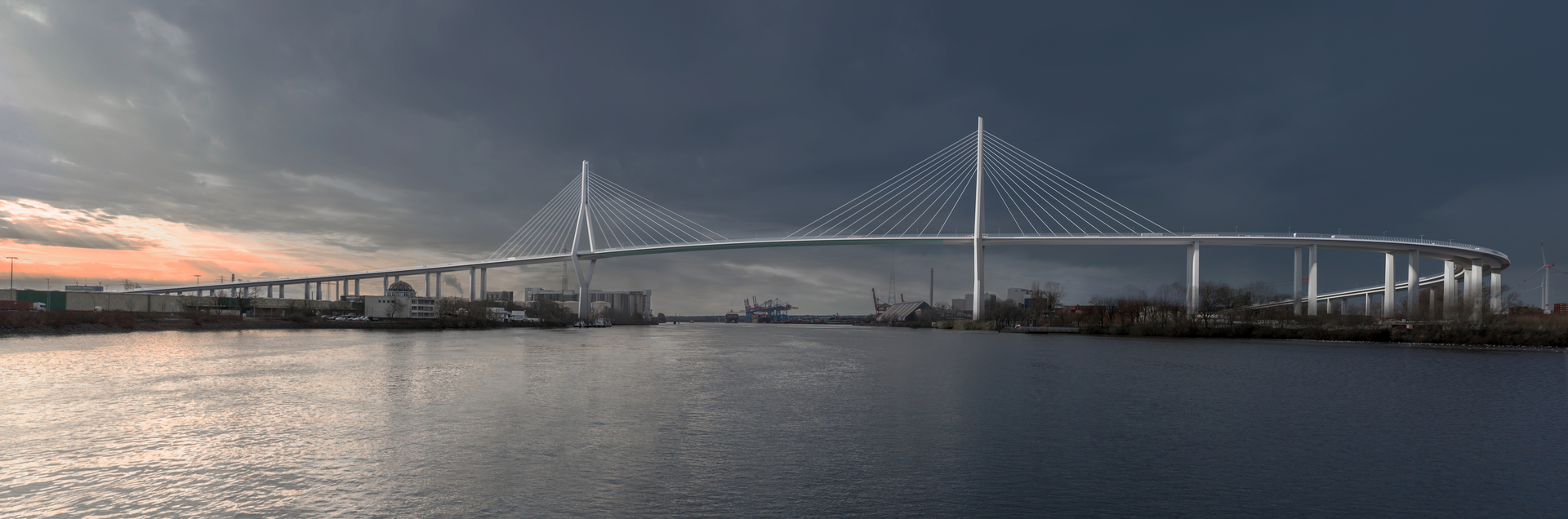
A new Hamburg icon: Nordic in character, clear in expression, understated in elegance, rooted in the legacy of the existing bridge yet looking firmly to the future. For the consortium, the new Köhlbrand Bridge makes the rhythm of the city visible. As the intensity and composition of traffic flows change throughout the day, the pulse of the port city becomes perceptible from afar.
The design developed by the consortium of engineering firms Grassl, schlaich bergermann partner (sbp), and WTM Engineers, together with gmp and PPL, aims to create a new Köhlbrand Bridge with landmark potential, capable of fostering identity through both its presence and its striking visual appeal. It continues the story of the Köhlbrand Bridge while carrying forward its emotional and technological legacy.
Harmonious Scaling
The harmonious proportions of the existing Köhlbrand Bridge are reinterpreted and further developed: greater height, longer main and side spans, and proportionately enlarged approach spans across the foreland areas. Slender structural elements minimize the visual mass of the bridge despite its increased scale. As the structure grows, so too does its transparency. From a distance, the delicate approach piers appear like a subtle hatching on the horizon. The deck seems to float above the silhouette of the harbor cranes, forming a true skyline of its own.
A Floating Superstructure
Owing to its larger scale and slightly adjusted alignment, the new bridge moves closer to the city and becomes more prominent within the urban landscape. Once again, it will rise above its surroundings, much as the current bridge did when it opened in 1974. At that time, it stood largely unobstructed. Over the decades, however, its surroundings have evolved, with extensive port facilities, silos, and cranes increasingly competing for visual attention.
The balanced proportions of today’s Köhlbrand Bridge are revisited and re-scaled in the new design. Once again, the bridge deck floats above the silhouette of the harbor cranes, establishing a distinctive new crossing that will shape Hamburg’s skyline for generations to come.
The Köhlbrand Bridge serves two essential functions: it organizes and channels road traffic within the Port of Hamburg while enabling vessels on the River Elbe to access key cargo handling and logistics areas in the southern port. As such, it is an indispensable link between land and maritime transport.
The bridge is the most important component of the port’s main transport corridor. As part of Germany’s federal highway B3, it directly connects the eastern and western sections of the port. It ensures efficient links between industrial facilities, cargo terminals, and logistics hubs without requiring lengthy detours or placing additional traffic burdens on neighboring urban districts. At the same time, it supports the complex and reliable collaboration between businesses located both within the port and throughout its surrounding economic region.
Economic Strength for Germany
The Port of Hamburg is one of Germany’s most important economic centers and the third-largest port in Europe. To fulfill its role as an international trade hub, the flow of goods passing through Hamburg must be efficiently connected to destinations throughout Germany and the wider European hinterland.
This is made possible by the outstanding regional and long-distance rail and road networks into which the Port of Hamburg is integrated. Within this transport system, the Köhlbrand Bridge plays a pivotal role. It provides a high-capacity connection between the port and the surrounding motorway network, ensuring the smooth and efficient movement of goods by road.
A Bridge Under Heavy Load
For more than 50 years, the Köhlbrand Bridge has linked the Port of Hamburg with the city. The demands placed upon it are immense: around 31,000 vehicles cross the bridge on a typical weekday, including more than 10,000 heavy goods vehicles (HGVs). Heavy freight traffic in particular has a disproportionately significant impact on the bridge’s structural integrity.
Designed in the 1970s, the bridge was not engineered to withstand such sustained levels of loading over decades. At the time, material fatigue, the gradual weakening of structural components under repeated stress, received comparatively little attention. Today, we know that these factors are critical to a structure’s service life. Material fatigue and the resulting structural deterioration cannot be reversed and ultimately preclude any technically and economically viable long-term rehabilitation strategy.
A Strategic Decision for the Port’s Future
From the maritime perspective, the Köhlbrand Bridge is equally significant. In 2025, approximately 4,271 seagoing vessels passed beneath the bridge, accounting for around 61 percent of Hamburg’s total seaborne ship traffic.
However, with a navigation clearance of 53 meters, the bridge restricts nautical accessibility and consequently limits development opportunities in the southern areas of the port. A replacement structure is therefore not only a transportation project but also a strategic investment in the long-term competitiveness and future growth of the Port of Hamburg.
By 2030, the formal planning approval application is expected to be submitted. The planning approval decision itself could then be anticipated in the early 2030s. This would be followed by an implementation and construction phase of approximately eight years, making the opening of the new main port route to traffic a realistic prospect by the late 2030s.
Around one year later, the Köhlbrand could be fully navigable without the current height restrictions imposed on maritime traffic. Final completion of the overall project, including the demolition of the existing Köhlbrand Bridge, could be achieved by the mid-2040s.
For the Free and Hanseatic City of Hamburg (FHH), Hamburg Port Authority (HPA), and ReGe Hamburg, the project delivery company responsible for implementation, accelerating the construction of the new Köhlbrand Bridge is a top priority. The goal is to bring the bridge into service by the end of the 2030s. To achieve this, the necessary resources are being established and maintained.
Since the strategic decision to replace the existing Köhlbrand Bridge was taken in June 2024, more than two years have already been saved in the overall project schedule. By dividing planning services into separate contracts and running planning processes in parallel, the planning phase has been shortened by approximately one year. Further optimization of construction methods and sequencing is expected to reduce the construction phase by an additional year.
Additional opportunities to accelerate the project will be pursued throughout the planning process. These include:
The total cost of the new Köhlbrand Bridge was updated to reflect current price levels as part of an alternatives assessment carried out in early 2024. The results indicate that the replacement bridge is currently estimated to cost between €4.4 billion and €5.3 billion (gross). This makes it approximately 25% less expensive than the bored tunnel option that was also evaluated.
A bridge is also expected to have lower operating and maintenance costs than a tunnel. Unlike a bridge, a tunnel requires complex technical systems that must be regularly maintained, upgraded, and replaced.
Against this backdrop, the Hamburg Parliament decided in June 2024 to proceed with a bridge solution for the new Köhlbrand crossing and approved €249.5 million in funding for the planning phase.
Given the Köhlbrand crossing’s critical importance to Germany’s largest seaport and the wider national transport network, a joint declaration was signed in February 2020 by the then Federal Minister of Transport and Digital Infrastructure and the First Mayor of the Free and Hanseatic City of Hamburg. The declaration formalized their shared commitment to delivering a new Köhlbrand crossing. Responsibility for the project remains with the Free and Hanseatic City of Hamburg.
A key prerequisite was the reclassification of the existing Köhlbrand Bridge as part of Federal Highway B3 within Hamburg’s jurisdiction. This took effect in February 2021 in accordance with Section 5a of the Federal Trunk Roads Act (FStrG).
At present, a binding federal funding commitment is not yet possible. The formal requirements for applying for federal funding have not been met. A completed design plan, including a detailed cost estimate, is required as the basis for a funding application.
Federal participation in project funding can only commence once construction begins. However, the start of construction falls beyond the horizon of the current federal budget planning cycle.
A look back at history provides a useful parallel: the original Köhlbrand Bridge, opened in 1974, also received federal funding in recognition of its significant contribution to Germany’s economy.
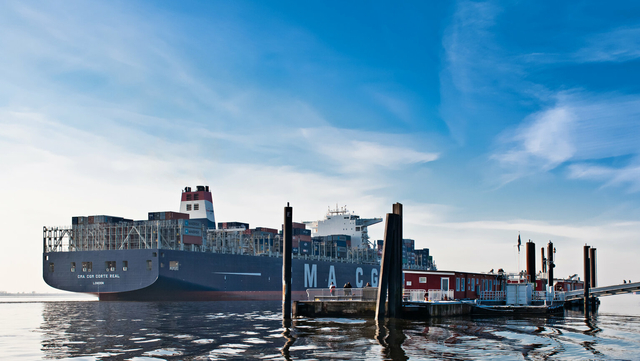
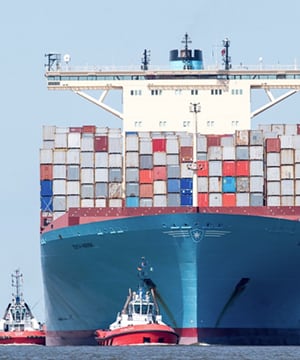
The Köhlbrand crossing serves two essential functions: it connects, channels, and organizes road traffic within the Port of Hamburg while simultaneously enabling vessels on the federal waterway River Elbe to access cargo handling facilities in the southern part of the port. However, due to the deteriorating condition of the existing structure and its navigational clearance of 53 metres above mean sea level (NHN), the bridge can no longer adequately fulfil these functions. For maritime traffic in particular, it already represents a significant constraint. With today's vessel dimensions reaching capacities of up to 24,500 TEU, the existing Köhlbrand Bridge can only accommodate ships of approximately 14,000 TEU or less, depending on their air draft. Such vessels now account for only a small and steadily declining share of the large container ships calling at Hamburg.
This challenge is expected to become even more pronounced in the future. Hamburg must continue to plan for moderate growth in vessel sizes, which will increase demand for modern berths capable of accommodating large container ships. These facilities must remain as flexible as possible, particularly during periods of peak cargo handling activity.
Today, the largest vessels operating in the Port of Hamburg are ultra-large container ships with capacities of up to 25,800 TEU and an air draft of approximately 67 metres above mean sea level, even with collapsible structures lowered. Taking into account the required safety clearances, as well as projected increases in average high-tide water levels, a navigational clearance of 73.5 metres above mean sea level would be required for a new Köhlbrand Bridge. This would place it on a par with major bridges along international shipping routes, such as the El Qantara Bridge spanning the Suez Canal and the Stonecutters Bridge in Hong Kong Harbour.
The new Köhlbrand Bridge will shape nautical access to the southern port for generations to come, likely extending well into the next century. Its greater clearance will represent a strategic long-term investment, safeguarding and expanding the development potential of the port areas beyond the crossing for decades to come.
The construction of a new Köhlbrand crossing is one of the most extensive, complex, and costly infrastructure projects undertaken by the Free and Hanseatic City of Hamburg in recent decades. Against this backdrop, a comprehensive and robust project governance structure has been established. Its key elements are as follows:
The Hamburg Port Authority (HPA) acts as the project owner and client. Its responsibilities include appointing the delivery organization, defining project requirements, specifying the port’s strategic requirements for the planning and construction of the crossing, managing public communications, monitoring budgets and schedules, and continuously reviewing overall project progress.
As the designated delivery organization, ReGe Hamburg Project Realization Company Ltd. (ReGe) has been commissioned by HPA to plan and deliver the new Köhlbrand crossing since 1 October 2023. ReGe is therefore responsible for the project's operational implementation and delivery, working closely with external partners, primarily engineering consultants and construction contractors.
The Ministry of Economic Affairs and Innovation (BWI) holds ministerial responsibility for the project. It chairs an interdepartmental steering committee comprising representatives of all relevant public authorities involved in the project. Under the Hamburg Port Authority Act (HPAG), the BWI is also responsible for financing Hamburg’s public port infrastructure.