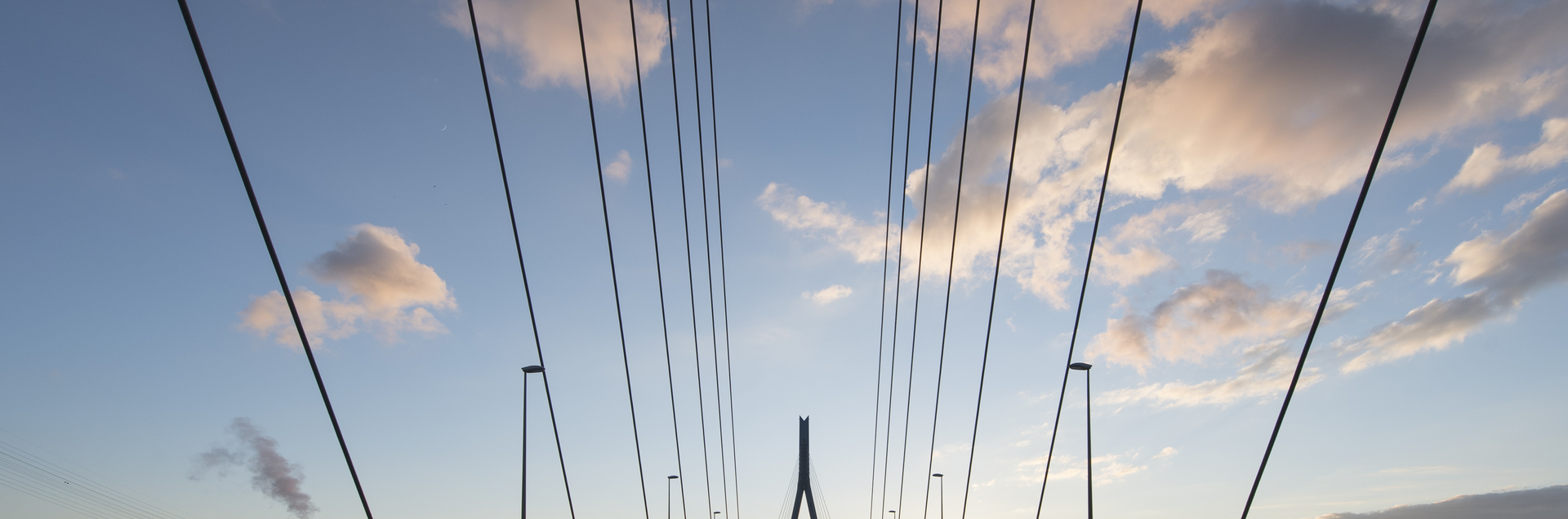
The load on the Köhlbrand Bridge must be reduced to ensure traffic safety and the bridge’s structural integrity. This is the conclusion of a recent assessment of the bridge’s structural condition. To further reduce the load on the structure, heavy transports weighing over 44 tons that require a permit will be rerouted starting May 1, 2026, and will no longer be allowed to use the Köhlbrand Bridge. The goal is to maintain the Köhlbrand Bridge’s continued operation for freight traffic until a future replacement structure is put into service. This will not result in any restrictions for passenger cars and trucks weighing less than 44 tons.
Since the bridge opened in 1974, traffic volume has nearly doubled. In 2023, approximately 32,000 vehicles crossed the Köhlbrand Bridge on an average weekday. In addition, truck traffic has nearly doubled since 1980. A single heavy-haul transport can cause more than a thousand times the damage of a normal truck, resulting in a disproportionate load on the structure and significantly faster wear and tear.
The Köhlbrand Bridge is of particular importance to the Port of Hamburg and has therefore been subject to rigorous inspections, continuous monitoring, and extensive maintenance for many years. The results of the current structural inspection now show an alarming increase in the rate of damage to the longitudinal ribs of the river bridge. Increased cracking and spalling, as well as significantly deteriorated material properties, are also evident in the ramp structures.
Based on a comprehensive technical assessment by the Hamburg Port Authority (HPA) and external experts, reducing the load is imperative to ensure the continued operation of the Köhlbrand Bridge and, thereby, the most stable possible traffic flow for regular traffic in the port.
Detour routes for heavy transport requiring a permit
Several alternative routes are available within the port area for affected transports; these may be used in coordination with the Traffic Directorate and the police:
A255 / Veddel Interchange, via Veddeler Damm, Am Saalehafen, Rampenstraße, Tunnelstraße
A1 / HH Stillhorn Interchange or B75 / HH Kornweide Interchange via Hohe Schaar Str., Kornweide
A7 / HH Hausbruch Interchange via Rethedamm, Hohe Schaar Str., Kattwykdamm, Moorburger Hauptdeich, Fürstenmoordamm, via Kattwyk Bridge and Retheklapp Bridge
Structural Condition and Measures
Structural inspections are conducted regularly on large structures such as the Köhlbrand Bridge and are categorized and evaluated in accordance with the guideline for the uniform recording, assessment, documentation, and evaluation of structural inspection results per DIN 1076. In addition to the main inspections, component-specific and additional special inspections are carried out when indications from the ongoing monitoring of the structure suggest this is necessary.
Maintenance measures are planned and implemented based on changes in the structure’s condition; in the case of the Köhlbrand Bridge, such work is prepared for the short, medium, and long term and, as far as possible, coordinated to occur during the shortest possible, consecutive closure periods on weekends to minimize disruption to port traffic. However, even comprehensive maintenance and renovation measures cannot halt the deterioration of the structure, which is why a ban on heavy traffic was introduced as early as 2012, supplemented in 2019 by a requirement for trucks to maintain a safe distance. The measure now implemented also serves to reduce the load and will be supplemented by further measures as necessary over time, depending on future developments.